The Model Context Protocol (MCP) is an open standard developed by Anthropic to enable consistent interaction between large language models (LLMs) and external systems like tools, databases, and file storage. It addresses the “N×M” integration problem—where multiple AI models must connect to multiple data sources—with a unified protocol. MCP was introduced in November 2024 and has seen rapid adoption by platforms including OpenAI, Google DeepMind, Replit, and Microsoft.
🏗️ Core Architecture
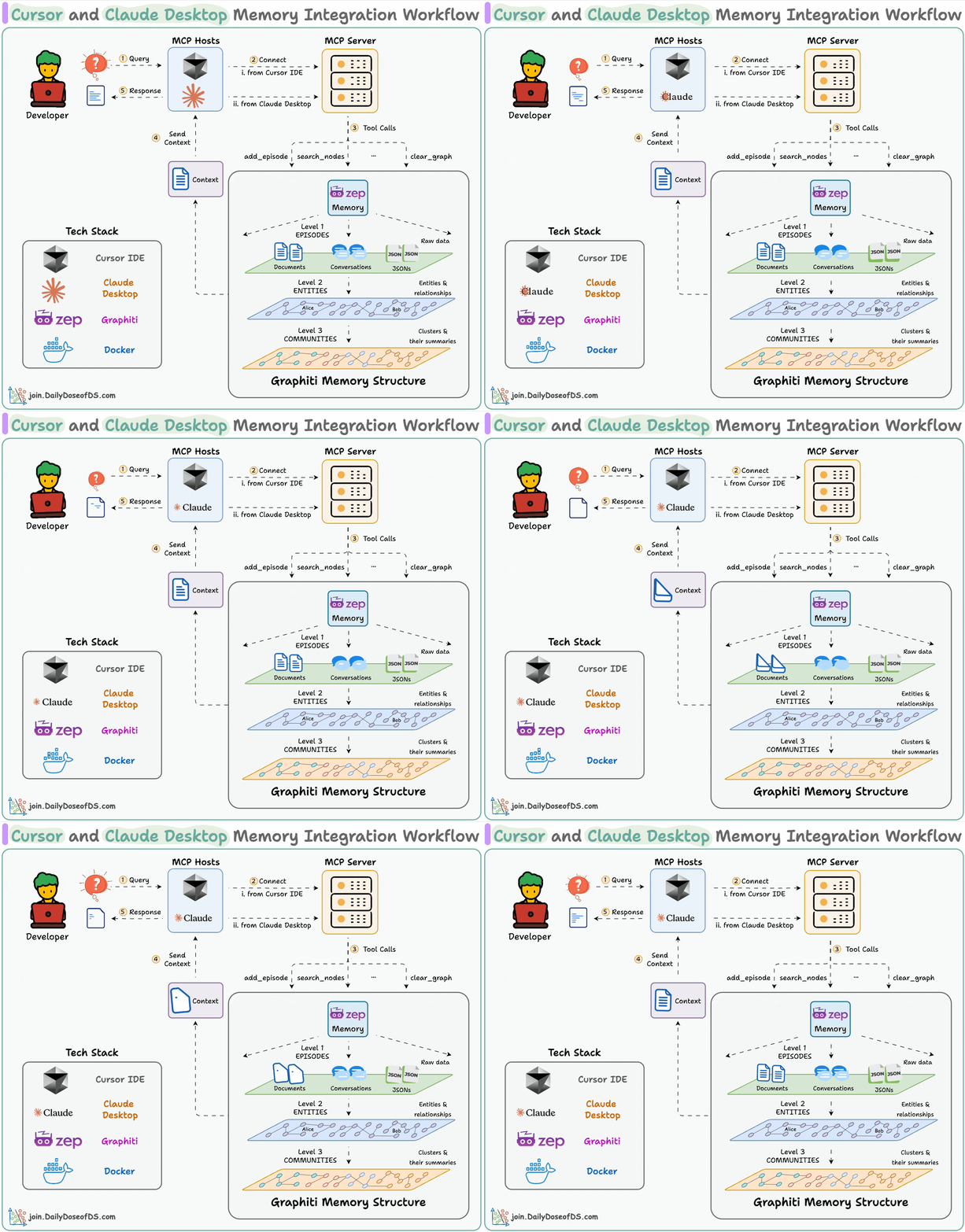
MCP relies on a modular host–client–server architecture built over JSON‑RPC 2.0. This design supports scalable, dynamic tool and resource access while maintaining clear boundaries and user consent flows .

Components Overview
- Host: The container application (e.g. Claude Desktop) that manages one or more MCP client instances. It handles permissions, security policies, and aggregates context across sessions .
- Client: The connector embedded in the host. Responsible for capability negotiation, tool discovery, resource access, prompt workflows, and JSON‑RPC messaging (sync or asynchronous). Supports transports like studio or SSE HTTP streaming .
- Server: External processes providing capabilities as “tools” (functions), “resources” (data streams like files or logs), and “prompts” (reusable templates/workflows). Servers negotiate supported features, respond to client calls, and manage structured logging. Processing logic, authentication, and state happen here.
🔄 Workflow & Negotiation Process
- The host launches client instances and orchestrates connections based on permissions.
- Clients connect to servers and exchange declared capabilities—tools, resources, and prompts.
- During interaction, clients invoke tools or resource queries over persistent JSON‑RPC sessions.
- Servers respond with structured output or data streams; clients format these back to the host/UI.
- The host enforces user consent for tool/resource access and maintains session context.
🔐 Security & Privacy
MCP emphasizes a local-first security model. Servers typically run locally unless explicitly permitted, requiring user approval before any access. Strict consent flows, logging, cancellation support, and error isolation are core to MCP’s design. Enterprise frameworks such as “MCP Guardian” offer additional protection like authentication enforcement, rate limiting, and tool sandboxing .
✅ Benefits of MCP Architecture
- Scalability: Hosts can connect to multiple servers in parallel without monolithic clients.
- Interoperability: Clients and servers conform to protocol spec and independent SDKs in Python, TypeScript, Java, C# .
- Modularity: Servers can be swapped or extended without updating clients or hosts.
- Standardization: Consistent patterns for tools, resources, and prompts enable reusable tooling across LLM platforms .
⚙️ Example Use Cases
- Desktop Assistants: Claude Desktop uses local MCP servers to expose filesystem or IDE context securely .
- Enterprise Assistants: Internal tools accessing CRMs, knowledge bases, databases like Postgres, GitHub repositories, or Slack .
- Multi-tool Agents: Agents coordinate across a suite of servers (e.g. calendar, email, code repo) for reasoning workflows .
🔚 Conclusion
The MCP architecture elegantly resolves the challenge of connecting language models with real‑world tools and systems. Its host-client-server design, JSON‑RPC foundation, and secure consent-driven access make it a powerful, flexible, and scalable standard. As growing support from OpenAI, Microsoft, Google DeepMind and others shows, MCP is fast becoming the backbone of agentic AI integration across platforms.


No comments:
Post a Comment